
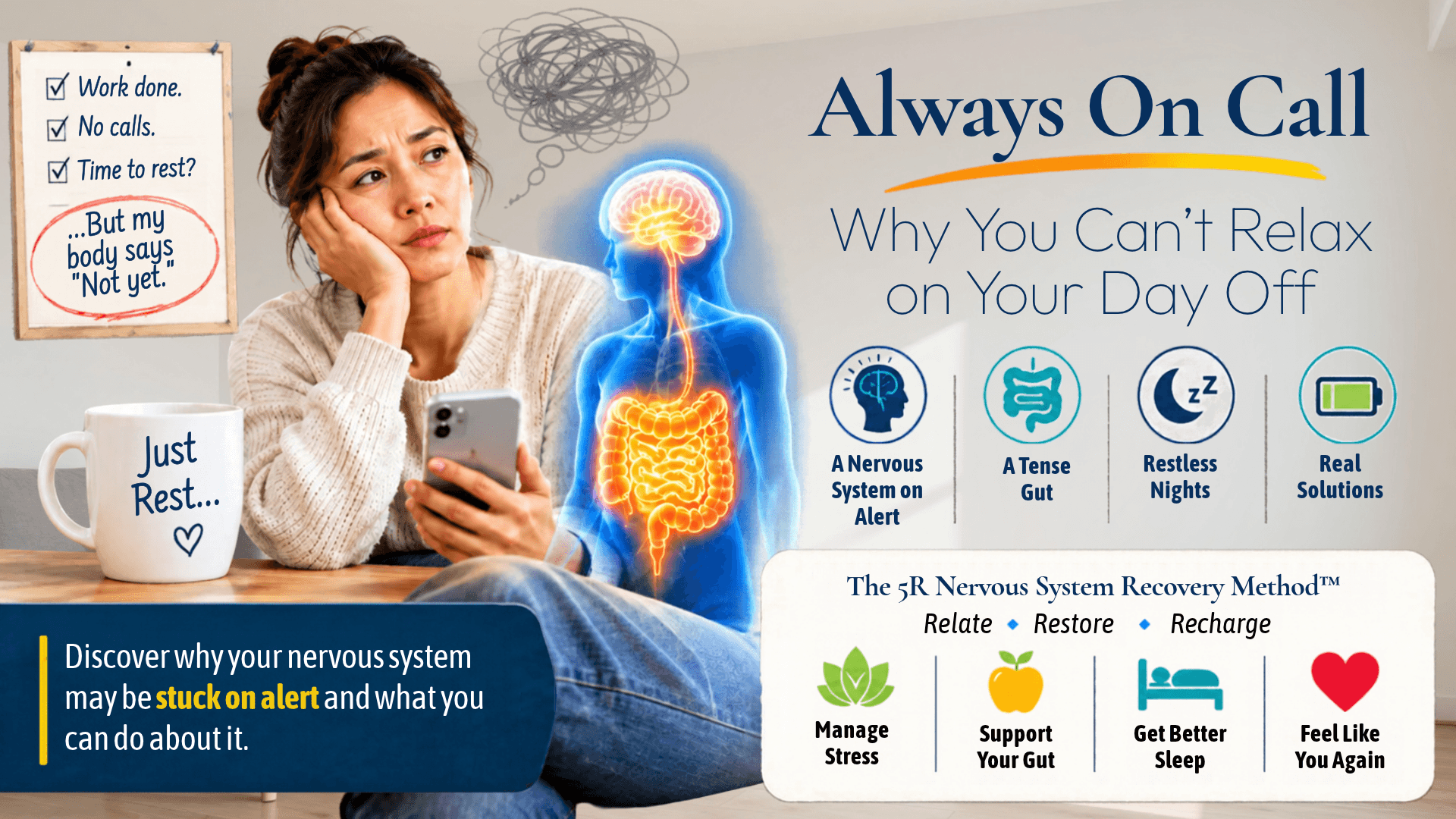
Always On Call
It’s Saturday, nobody needs anything, and your body still won’t land.
It’s Saturday afternoon. Nobody needs anything. You checked. The week is finally over and there’s nothing on the list that has to happen today. You sit down on the couch with the whole afternoon open.
And your body will not land. If you’ve ever wondered why you can’t relax on your day off, this is usually where it shows up first.
You pick up your phone. Nothing. You put it face down. Ten minutes later you pick it up again. Your shoulders are up near your ears. You lower them, and a minute later they’re back. Your stomach is tight the way it gets on a workday. You think about laundry, about texting someone to check in, about whether a coworker was upset with you on Thursday.
By evening the day is gone. The laundry is still in the basket. The book on the side table hasn’t been opened. And you haven’t rested either. Six hours have passed in a kind of holding pattern, and tomorrow is Sunday, and Sunday has its own feeling.
The story you’ve been told
You’re just wired this way. Some people are high-strung, and you got that setting. You’re bad at relaxing; everybody says so. Your stomach acts up because you’re stressed, and you’re stressed because you’re busy. And you’d rest more if the people around you needed less.
That last part of the story carries a lot of weight, because it puts the problem outside you. If the calls stopped, you’d finally rest. But you’ve had the quiet Saturday. You’ve had the vacation, and spent the first two days of it checking on everyone you left behind. You’ve put the phone in a drawer and thought about the drawer all afternoon. The rest didn’t come anyway. And that’s usually when the story turns back toward you. Maybe you’re broken in some way that meditation was supposed to fix.
There’s one more piece woven through this. You know the moment when someone says, “I don’t know what I’d do without you.” It lands somewhere real. For a second, everything makes sense. You’re needed, so you’re okay. For a lot of helpers, being needed is the closest thing to safety they’ve ever known, and a system can learn to keep working for the next moment like that. The thank-you is real. It just isn’t rest.
So it isn’t the people around you, and it isn’t a flaw in you. Your system may be on call, even when nobody is calling. Being on call is a state your body is in, and states can change. But a state doesn’t switch off just because the phone stopped ringing. Somewhere along the way your nervous system learned that being needed is how you stay safe, and nobody has told it the shift is over.
The architecture
Your nervous system has two broad modes. One is built for action: alert, scanning, ready to move. The other is built for recovery: digesting, repairing, sleeping deeply. A healthy system moves between them through the day.
There’s a middle setting that rarely gets named. It isn’t full alarm. It’s listening, a low, steady readiness for the next need. That’s what being on call looks like inside the body.
Digestion happens best on the recovery side. A large nerve called the vagus nerve runs between your brain and your gut and carries signals both ways. When the system feels safe, it helps switch digestion on. When the system is listening for the next need, digestion tends to get demoted. Over weeks, that may look like a stomach that’s tight on workdays. Over years, it can look like the panel from last week’s episode.
The signals also run back up. A gut that’s been pushed aside for years tends to send unsettled signals to the brain, and a brain receiving them tends to stay alert. The on-call state and the unsettled gut can keep each other going.
Your gut may know you’re on call, even when your calendar doesn’t.
Then there’s the night. You probably know the two a.m. inventory: who needs a reply, who seemed off, what might go wrong tomorrow. It’s less like worry and more like standing watch. In Chinese medicine, this kind of pattern is often described as Heart and Spleen blood deficiency, the worrier who can’t settle at night. In plain words, the reserves that let the mind go quiet appear to get spent on vigilance. What I often see on labs alongside it is a cortisol rhythm whose evening reading stays higher than it should. A healthy curve falls through the day so you can come down. Here, it stays up in the wrong place.
An organic acids test can go further than a standard panel, showing breakdown products related to the brain’s chemical messengers. In this pattern, those can suggest a system that has been running its alertness chemistry hard for a long time. It’s one piece of the picture, never the whole thing.
A case in the practice
Let me tell you about someone I’ve been seeing in the practice. They work with kids all day. Their main complaint was their gut, and the pattern was strange. It wasn’t worst after any particular food. It was worst on Sunday nights and the first two days of a hard week.
They’d done two careful elimination diets and come away with nothing, which had left them feeling like they’d failed the diet. We ran a cortisol curve. Their body appeared to be making its stress hormone at the wrong times of day: lower in the morning, higher at night. When I asked about evenings, they described the inventory almost word for word.
This is what I’d call the Holder pattern, one of the three archetypes I use in the practice. The Holder holds; the system never fully comes off. In the gut, a Holder’s symptoms tend to track the week, not the plate, which is likely why the diets came up empty. They were looking for a food, and the trigger appears to have been the state.
The first thing we worked on wasn’t food at all. It was the evenings, giving the system a clear signal that the shift was over. A few months in, Sunday nights weren’t the worst night of the week anymore. That’s one person, and every body is different. But the order matters: the state first, the food second.
What this means for you
Stop treating the inability to rest as a personality flaw. Your system has been on call for a long time, and it learned staying on watch very well. It can learn coming off watch too. That’s a skill, not a trait, and skills get practiced rather than forced.
The way I work with this comes from three places at once: functional labs that can show what the on-call state has been doing, Chinese medicine, which has been reading patterns like the worrier who can’t settle for centuries, and trauma-informed coaching, because a nervous system that learned to stand watch usually learned it for a reason. That’s the work of the 5R Burnout Recovery Method™, built over twenty years and more than sixteen thousand patient visits. This month we’re in Relate, the stage about where your energy goes and who it goes to.
If your system has been on call this long and you want help with the nervous system piece specifically, the smallest door I offer is Stress SOS: six private sessions over four to six weeks, no lab work, built for a system that hasn’t been off duty in years. You can find it through booking a discovery call, whenever the timing is right.
You were never meant to be on call forever.
What to notice this week
No fixing. Just noticing.
First, notice what your stomach does when your phone buzzes, before you look at it. Body first, then the message.
Second, notice how fast you answer when someone asks you for something, and what your body does if you let a request sit, even for a minute.
Third, notice the half-second right before you say yes. Most helpers have never caught it, because the yes moves so fast. See if you can find it once this week. That half-second is where next week starts.
Listen to this week’s episode: APPLE PODCAST · SPOTIFY LINK
Watch on YouTube: YOUTUBE EPISODE
Find me on Instagram @doctorrileysmith and YouTube @doctorrileysmith.
Your body is telling the truth. I can show you the proof.